Wednesday, October 28, 2015

Multicultural Projects


Last year I worked in a primary school with children between the ages of 6 and 12 years old.  I was an Auxiliar de Conversación in the art classes. One of my goals while working with children was to incorporate some form of multicultural awareness because I think it is important for children to know that the world is a diverse place and that diversity is a beautiful thing to learn from.  I wanted the children to see the world through different lenses and from different perspectives. I did this through a few classes in which we learned about the Harlem Renaissance, Dream Catchers, and Native American Shields.  Each of these projects was meant to show the children something new and interesting about the culture and allowed them to express themselves through art.  

This post will be about ways to take these complicated ideas and simplify them for a younger audience.   The aforementioned projects involve the Black American population and the Native American population in the US.  Both of these populations come with difficult histories and it is difficult to try to simplify the ideas and the culture so that a child can understand it. Hopefully at the end of this post, you will gain my perspective on the matter of how to try to do exactly this.


Step 1- Time and Communication

I would not recommend delving directly into a project involving multicultural awareness if you want the children to learn something. It’s easy to just hand the children something to color and not mention anything about what they’re coloring. The problem with this, is although whatever they are coloring may be something from another culture, the kids aren’t learning anything. They’re just coloring; something they do often in art classes. 

            If you want the children to learn something and have a take away message then you need to start preparing the class at least a month out. You should let the teachers at your school know as soon as possible that this is your plan so that they can help you with the idea and give their input.   You definitely want their input, because these teachers have taken classes in education and they know different strategies for exposing the children to the content. The teachers might also tell you that it may be better to tie in your lesson into another part of the year when the children are discussing something in their English classes they may be pertinent to your project. For example, the Harlem Renaissance involves a lot of artwork, so perhaps it would be better to do your project around the time that the children are learning about art and how to describe it in their English classes. This is also a way to avoid scheduling conflicts with other projects the other teachers are planning on doing.

PS: Definitely consider timing if you need students to purchase materials for your project.


Step 2-  Start Small

There’s a quote from themovie Inception where one character explains to Leonardo Di Caprio how to implant an idea into someone’s head. He mentions that you need something simple, small, and basic.  Then he continues to explain how the idea will grow by itself afterward. That’s the case here. You want to think of something concrete that you want the children to learn. The idea can be as simple as “Native Americans are people” or “Christopher Columbus did not discover America” or “Native Americans made weapons with pictures”. You want a simple idea.  An easy way to determine this idea is to ask yourself “Why is this important to me?” “Why do I think this is important for other people to know this?”. Once you ask yourself these questions, think of your responses, and you will start seeing a trend amongst your responses and that will typically lead you to your “basic idea”.

Then you let that idea grow.  The importance here is that you have this basic idea that is the concept you want the children to understand when everything is all said and done.   It’s your bare minimum.   You work with that idea and try to make it work for your classes.  Step 1 is important here because you give yourself time to allow this idea to grow. 

Sometimes it is possible you may have multiple basic concepts you want to get across. In those cases, I think it is best to grow each of the ideas and see which one is the one easiest communicated and choose that one.


Step 3-  Growing the idea

This step is the most labor intensive. Once you have your basic idea, you want to brainstorm the idea.  While in this step, I normally plan out different lesson plans, research information, and make sample projects for the children to later see. 

I plan out the different lesson plans to think of how to best present the information. While doing this I think of the following questions:
-       Do I want an interactive presentation?
-       Do I want to do a PowerPoint?
-       Do I want to do a poster?
-       How will the younger kids respond to chosen method of presentation?
-       How can I adapt the presentation to the age groups?
-       How much time does it take to give the presentation?
-       What questions might the students have? (Research potential questions)
-       Will I best be expressing my simple idea?
-       What problems may come up in the presentation?
-       What images can I use to communicate my ideas to the children?
-       Will the children like the presentation?
-       Will the children be bored in the presentation?
-       Can I use literature, music, or art in this presentation to make it more effective?
-       Is this relevant to the English-speaking world?
-       How can this be used in Spain?
-       How can children use this in their own lives?

All of these questions can be answered during the research phase. In the research phase, I take the time to sift through information on the Internet.  It’s during this moment that I tend to think critically about how to adjust the ideas to the different age groups.  For little children, what’s the most appropriate way to introduce them to race and not bore them or scar them at the same time. I research games and activities for children to let them explore the ideas of race.  For example, based off of a video I saw from the 1970s about a teacher separating her class by eye color, I did something similar with my students (with the permission of the teacher). The video is below, if it doesn't appear search youtube for "Jane Elliot blue eye brown eye segregation" and it will appear. I entered the classroom one day, and I told the kids with brown eyes to stand in one corner, kids with green eyes in another, etc. I segregated the classroom by eye color.  Then I said the kids with brown eyes could sit down because they are good because they have brown eyes. (You can make up anything arbitrarily).   This continued for a little bit longer until one kid said it was unfair. Then the teacher and I discussed with the children how they felt and why. Then we asked how would they feel if someone treated them like that only on their eye color.   We asked if they felt it was nice to treat their friends that way.  With that discussion we introduced the idea of the problems that Nelson Mandela had to face.

When planning your examples of race and problems with the children, it helps when it is something that they can see. So try to plan your examples to include the students and their friends in the classroom. 


Step 4 Make Presentation

After doing Step 3 and researching your information, you can now start making your presentation. While making the presentation keep your “basic idea” always in mind and make sure that each part of your presentation is a stepping stone toward your idea.

I normally make the most difficult presentation first for the children in the 5th and 6th grade.  These are the children that tend to understand the most English and can more easily grasp difficult ideas. Then I begin to take away slides with information that maybe isn’t as relevant as other information in my presentation for the 3rd and 4th graders. After that I remove more information to make the presentation more accessible for the 1st and 2nd graders.

As you reduce the difficulty of your presentation be sure to add more multimedia resources. For example, during the Harlem Renaissance I wanted to talk about the different musicians and the styles of music.  For the older children, this was more important, for the younger levels, I removed the historical part discussing music and I added more clips of people singing and dancing.   I also added in more active activities for the younger kids to let them practice drawing dancing body parts.

Step 5  Communicate Again

Teachers are busy people and sometimes things slip your mind.  With this in mind, it is a good idea to remind the teachers of your project and to show them your presentation to see what they think about it.  The teachers will give you advice if they think it is too hard for the students or too long. Listen to their criticism and try to mold your project accordingly. If it’s the case where one of your teachers is just a hater for unprofessional reasons, let them hate.

           
Step 6 Show Time

This is the moment to have your lesson with the children. Be sure the teachers are present in the very beginning to help facilitate activities. If you have decided to do an activity to show “racism” to the children, you need to coordinate it with the teacher.  While talking about the topic, continue to ask children how they would feel if they were in a similar situation. For example, after discussing the Great Migration, I asked students what they would think if something like this happened in Spain. How would they respond? How would they feel? How would their parents feel? If your conversation goes off on a tangent because students are interested (and assuming it is still relevant), go with it.  Let the children ask questions, and try to answer the questions to the best of your ability.  Be sure to keep an open mind, if you don’t know an answer, it is okay to say, “I don’t know”.  When that happens, ask children what they would say or think. For example, while presenting about the Americas having different names before they were called “America”, the children inquired about the names for South America and North America. I told them, that I didn’t know and that I’d get back to them next week.

As you give your presentations, be sure to adjust them to each class as you see fit.  For example if you have 4 different 6th grade classes and you see after the first 6th grade class that a certain slide was too much, perhaps you can trash the slide, and give your presentation without it. If you see an activity that worked really well, you can hone it for the next 6th grade class.


I hope that this post helped a bit on how to go about multicultural activities with children.  If I missed something, or if you have a comment, please leave it below.


Monday, June 9, 2014

The Haliwa-Saponi Experience! The Black Experience! The American Experience!

A person recently asked me about my experience in Galicia as a person of color.  So, I thought it’d be a good idea to actually address my experience in Galicia as a person of color. 

A picture of me being blinded by the sun. 
First off, I believe everyone is a person of color.  We all played with crayons as children and there was always, white, black, yellow, red, blue, orange, and green in the box.  In my case, my dad is Black and my mother is Haliwa-Saponi, so I’m high-yellow or “café con leche” in Spain.

Before I came to Galicia, my mom joked and told me not to go because there weren’t any Black folks there! However, I would urge all folks who are “of color” to not be afraid.  If you let your skin color hold you back, you’ll never get anywhere in life.  If Crayola thought your “color” was good enough to go in a crayon box, it’s damn sure good enough for you to travel with that same “color”.


1 .)  Mistaken Identity

The local Saturday market
 My town is a small fishing town with about 14,000 residents. It’s located along a coastline in Galicia.   The region receives a lot of immigrants due to its large fishing industry.  There are many African immigrants, mainly from Senegal and Morocco.   The immigrants from Senegal and Morocco have only begun migrating here a few years ago.

Due to these influences, I’ve been mistaken for Senegalese, a Cuban, and seldom a Moroccan.  From my general experience, no one looks at me and assumes that I speak English.  Once people hear me speak, then they find out that I am American or British. 

Another photo of the local Saturday market

I do not believe that my other companions with bright blonde hair and blue eyes find themselves in the same situation as me.  If folks in my town see someone with blonde hair and blue eyes, the natural assumption is that they are American.  I believe this peculiarity is due to various factors but I can’t shake the feeling that the general lack of non-White folks going abroad is a contributing factor.  Many times it seems to me as if folks forget that the United States is a country composed of many colors and that we’re not all fair-skinned.


2.) Veña negriño o Veña negriña o dígolles Goodbye Nigga!

Spanish folks have inherited a lot of English words into their language, like: “feeling”, “wi-fi”, “sorry”, “okay”, “gay”, or “sexy” to name a few.  A word that shocked me to hear here was “nigga”.  This is a word that makes me uncomfortable to say and I find myself at a lost as to whether I should embrace the word or shun it as many others.  I associate the word with its slavery meaning and the destruction and unification it has brought to African-Americans since.   The word “nigga” has entered Spanish slang through music but many folks have no idea of its original meaning and think it is just a term for friendship between two people.  It entered the language in much the same way as “gay” has entered their language without it’s original meaning of “happy”.  I have heard the word being used a few times in a few of my classes.  Whenever this has happened, I took a few moments to explain the original significance of the word, or corrected the students to use the term “Black man”. Most of the students are alarmed at the original meaning because they only thought the word had a friendly meaning.

The word for black in Spanish is “negro”.  On occasion, I’ve been referred to as “el profesor negro” when parents are unsure of what my name is.  As a warning to Black folks coming to Spain, do not take offense when people use the word like that.  It at first made me a bit uncomfortable because I kept thinking about the word “negro” in English and it’s outdated usage. 


3.) Fucking Paparazzi

The Spanish Atticus Finch and I 
I have encountered a few folks in Spain that wanted to take a picture with me.  Although none of the groups mentioned outright it was because I was Black, it just seemed very obvious.  On both occasions, I was in a crowded location, only Black guy, and the groups approached me asking to take a picture with me.  On one of these occasions, one of my friends flipped out on the group of guys saying they only wanted my picture because I was Black.  After my friend accused them, the men started claiming a bogus story about wanting to take a picture with me because I pee with a serious look on my face before they finally gave up on wanting to take my picture.   This happened to me in Scotland as well, but the man kindly explained to me that I looked like Cleveland Brown from the Cleveland Show.  You can choose to permit folks to take a picture with you or deny it.  It’s a strange thing to me, but I had to realize that I am just as much a part of these peoples experience and history as they are a part of mine.  On one hand I can understand why, but on another hand it makes me feel as if I am an exotic animal.


4.) Stereotypes

I have encountered a lot of stereotypes here.  The first stereotype that caught me off guard is the number of folks who subscribe to the “Black-men-are-as-hung-as-horses” belief.  A lot of people here believe that rumor and I believe I’ve met more people in Spain believing in that than Americans.  I’m not going to discuss the accuracy of the statement but it is shocking to hear so many people talk about it when they meet you. 

They think a Black guy's penis is as big and black as this fish. 
People think you can sing. I know someone who always asks me to show him my “Black voice” because all Black people can sing.  When I try to reason with him and say that I can’t carry a note, he doesn’t believe me. 

Some people may want you to speak like a cliché Black person.  This happened to me about a month and a half ago. I was talking to a woman about something and she kept asking me “how would YOU say it?” implying that she wanted me to say it in a cliché “Black” way.  I found it rather infuriating; because she was under the blanket assumption that I spoke like every Black cliché she had ever met.


5.) Racism

Only reach down if you plan on helping your neighbor up.
I have not experienced blanket racism here.  I haven’t heard people using the expression “negro de mierda” like Argentines are notorious for.  I’ve yet to see a Spaniard that just hates me because of my skin color.  On the opposite hand, I feel as if I’ve experienced more racism within the United States than I have in Spain.  However, I can see a lot of the same racist problems we have in the United States being carried out in Spain.  The only difference is that the skin color and nationality changes.  In Spain, the people who are mistreated are the Romanians or distastefully called “Gitanos”.  In a later and separate post I will discuss the racism that I see against Romanians here in Spain and how it compares to the United States.

In general, many Spaniards have been curious to hear about my experience in the United States as a   Many folks have asked about whether or not the United States is still as racist as it once was in the past.  I always let them know that the racism is still there but it has metamorphosed into another form of racism.  This curiosity at first came off as a tad racist to me because it seemed as if they were singling me out only because of my skin color (more prejudice I believe).  But after a few months, I realized that these people were asking questions out of curiosity because they wanted to take advantage of the fact that I was not White to hear my take on things in the United States as a minority.


These are my experiences in Galicia.  Everyone’s experience is different with respect to who they are physically, emotionally, mentally, spiritually, sexually, jokingly, spanishly, englishly, lovingly, talkingly, personally, kissingly, dancingly, churchly, angrily, happily, galicianly, octopusly, rabbitly, manly, womanly, malely, femalely, zirly, riverly, oceanly, ecologically, etc.  I learned that if I try to understand where folks are coming from, a lot of “racist things” are just pure curiosity.  So I would encourage all folks coming to Spain to just take “questions” with a grain of salt and respond politely. 

Monday, May 12, 2014

Things I've Learned from Being Abroad


As it stands, I have lived in Scotland, Argentina, and now Spain for a chunk of time.  There are many things that you learn or experience about being abroad that are unique. 


1.)       Rubber. Rubber. Rubber.  
I don’t care what it is, but you need to get something that is made with some part of rubber.  Personally I like to have a pair of shoes with rubber soles because they are slip-resistant.   But rubber is also great because it does not conduct electricity. Whenever you have an electrical problem while abroad and are afraid of getting shocked. I can bet you that you won’t have a pair of rubber gloves nearby, so your next best option will be that rubber object.  This happened to me when I was in Scotland in my apartment.  I was using an international adapter and all of a sudden it began shooting sparks everywhere.  I freaked out because I needed to remove it before it caused an electrical fire. I quickly grabbed my shoes with the rubber soles and yanked it out the wall.   Had I not had the rubber gloves, I would’ve been at a lost and probably would’ve improvised but having the rubber-soled shoes really saved me the hassle.  Also, don't forget rubbers when you have a night with a foreign lover.   He or she may seem exotic or foreign but wrap it before y'all tap it because foreigners can carry just as many sexually transmitted diseases as anyone else.  Don't be caught like the guy from Christopher Columbus' boat who came back from visiting the New World and the only souvenir he had was Syphilis. 


2.)       Your race changes from country to country.
The concept of race is a cultural phenomenon. You will learn that what you grew up considering the cultural norms of what is Black and what is White and what is Hispanic will get flipped on its head.  For example in the United States, I am a Black man although I consider myself Black and Native American.  In Spain, I’m considered “mulatto” because I’m not Black.  For Spaniards a person that is Black is actually dark-skinned in this sense of the Senegalese population that resides in Spain.  So when my high yellow self hopped off the plane, the Spaniards were like, you’re brown not black.  In addition to your race changing, you’ll start viewing race in a different way as well.  Through my travels in Spain, Spaniards come in a large variety of skin colors that one would easily consider Hispanic or Black in the United States but they’re still considered White due to Spaniards being Europeans. 
     The racial binary that prevails in the United States about White vs. Black is not as apparent in Scotland or Spain.  Whenever a conversation with race comes us, Spaniards and Scotsmen/women seemed baffled by the racial problems that we have in the United States.  But what I am slowly realizing is that the binary hasn’t disappeared, it just has a different form. In my part of Spain, the binary seems to be Spaniards vs. Gitanos (Romanian immigrants in Spain).  


3.)       Crazy people are everywhere
While traveling abroad you meet many wonderful folks that help you along the way.  In this process though, you’ll meet a few crazy people and a few jackasses.  Your definition of crazy may be different from mine, but for me a crazy person is one who believes that you and them have imaginary plans, shouts at you for no reason, stands you up, etc.  Perhaps I am combining jackass and crazy into one, but eh, there are jackass crazy people.  You’ll never see these folks coming, so it is important that when you realize you’re with a crazy person or a jackass that you say what you need to as concisely as possible to come up from out of the situation.  Sometimes it may be as simple as saying “Hey, this wont’ work for me.” or sometimes you may have to get a bit “real” and use your street “Spanish” or any other language when situations get out of hand. Also if you hang out with enough native people of your town, they’ll help you spot a crazy person from a mile away.  For example, they may say, “Oh this is Xurxo, beware of him because he’s an utter and complete jackass.”  (All Xurxos that I’ve met have been fantastic people.
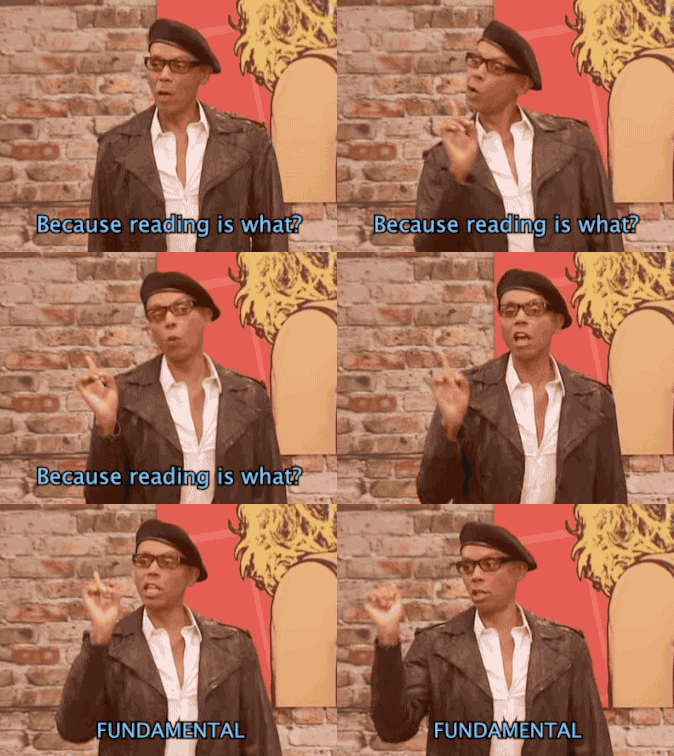
4.)       Reading is fundamental.      

I have always been a fan of RuPaul’s quote about reading being fundamental. It’s a very true statement and more important when you find yourself in another country.  Read everything you can.  Read the newspapers, the signs, on occasion the people, read information about your town online, and read Google.  You can acquire a lot of information very quickly just by reading about what’s going on around you.  It’ll also help you adjust and become part of the country’s culture.  For example, one day I was in a bar and while waiting on my food, I decided to pick up the local newspaper. I read about the recent passing of the first Democratic President of Spain (which is a big deal because up to about 1975 Spain was gripped by the dictatorship of Franco). From reading the newspaper, I learned about the difficulties Spain had from transition from a dictatorship to a democracy and how Adolfo Suarez unified the country.  Reading also keeps you abreast of the politics that may be affecting your local area and it always provides a good talking point for you when you want to strike a conversation with the locals. 


To be continued...